
Conditions
Hip pain and injuries
Hip pain is often not where the hip is. Pain in the groin usually is the joint; pain on the outside of the hip is usually the tendons over it; pain in the buttock is as often the back as the hip. Getting that sorted out at the first visit is most of the work, because the treatments are not interchangeable.
See a doctor first
Hip pain with any of the following needs a physician or an emergency department before a therapy visit:
- You cannot put weight on the leg after a fall, especially if you are over 65 or have osteoporosis — a hip fracture can be walked on and still be broken
- A hot, swollen joint with fever
- Hip or groin pain in a child or teenager who is limping, which needs a doctor promptly
- Pain with unexplained weight loss, night pain that does not ease with position, or a history of cancer
- Numbness in the groin or any change in bladder or bowel control
What we see most
Hip conditions we treat, and what therapy does for each.
Hip osteoarthritis
Wear of the joint cartilage, usually after 50. Groin or front-of-thigh pain, morning stiffness, difficulty with socks and shoes, and a hip that will not turn inward the way it used to.
What therapy does: Every major guideline puts exercise and education first for hip arthritis, ahead of injections and well ahead of surgery. Strengthening the hip and thigh muscles reduces pain and improves walking for most people; therapy cannot regrow cartilage, and we will not claim it can. Many people delay replacement by years, and those who do go on to surgery recover faster for having done the work.
Gluteal tendinopathy and trochanteric bursitis
Pain on the outside of the hip, worse lying on that side and climbing stairs. Long blamed on a bursa; now understood to be mostly the gluteal tendons, and most common in women over 40.
What therapy does: This responds well to a specific approach — education on which positions compress the tendon, and progressive loading of the gluteal muscles — which outperformed a corticosteroid injection at one year in a randomized trial. Stretching the outside of the hip, the intuitive thing to do, usually makes it worse.
Hip impingement and labral tears (FAI)
A mismatch between the ball and socket that pinches the joint's cartilage rim in deep flexion. Typically groin pain in active people in their 20s and 30s, with sitting, squatting and pivoting.
What therapy does: Trials comparing arthroscopic surgery with a structured physical therapy program show surgery has a modest edge for some, and that a good share of people do well with therapy alone. We restore hip and trunk control, adjust the movements that pinch, and give you an honest read on whether a surgical opinion is worth having.
Hip replacement recovery
Rehabilitation after a total hip replacement, from the first days after surgery to walking without a limp and returning to what you enjoy.
What therapy does: We follow your surgeon's precautions to the letter, then progress you through walking without aids, strength, balance and the specific demands of your life. Total joint replacement rehabilitation is offered at nearly every SportsCare clinic, so it can happen close to home.
Hip flexor and hamstring strains
Muscle strains at the front or back of the hip, common in sprinting, kicking and sudden changes of direction. Hamstring strains recur often when rehabilitation is rushed.
What therapy does: The evidence for hamstring rehabilitation favors early, progressive loading — including lengthened-position strengthening — over rest and stretching. We grade the return by measured strength and a symptom-free sprint, not by the calendar, because returning too soon is how these become a season-long problem.
Is it the hip or the back?
Often the first question, and not always an easy one. Buttock and outer-thigh pain can come from the hip joint, the gluteal tendons, or a nerve root in the lower back, and each needs a different plan. The first visit includes an examination of both the hip and the lumbar spine so treatment starts at the right place.
For hip pain without red-flag signs, X-rays are useful to confirm arthritis but rarely change the initial plan, and MRIs find labral tears in many people who have no pain. Imaging comes first after trauma, in children, or when the picture does not fit.
What treatment looks like
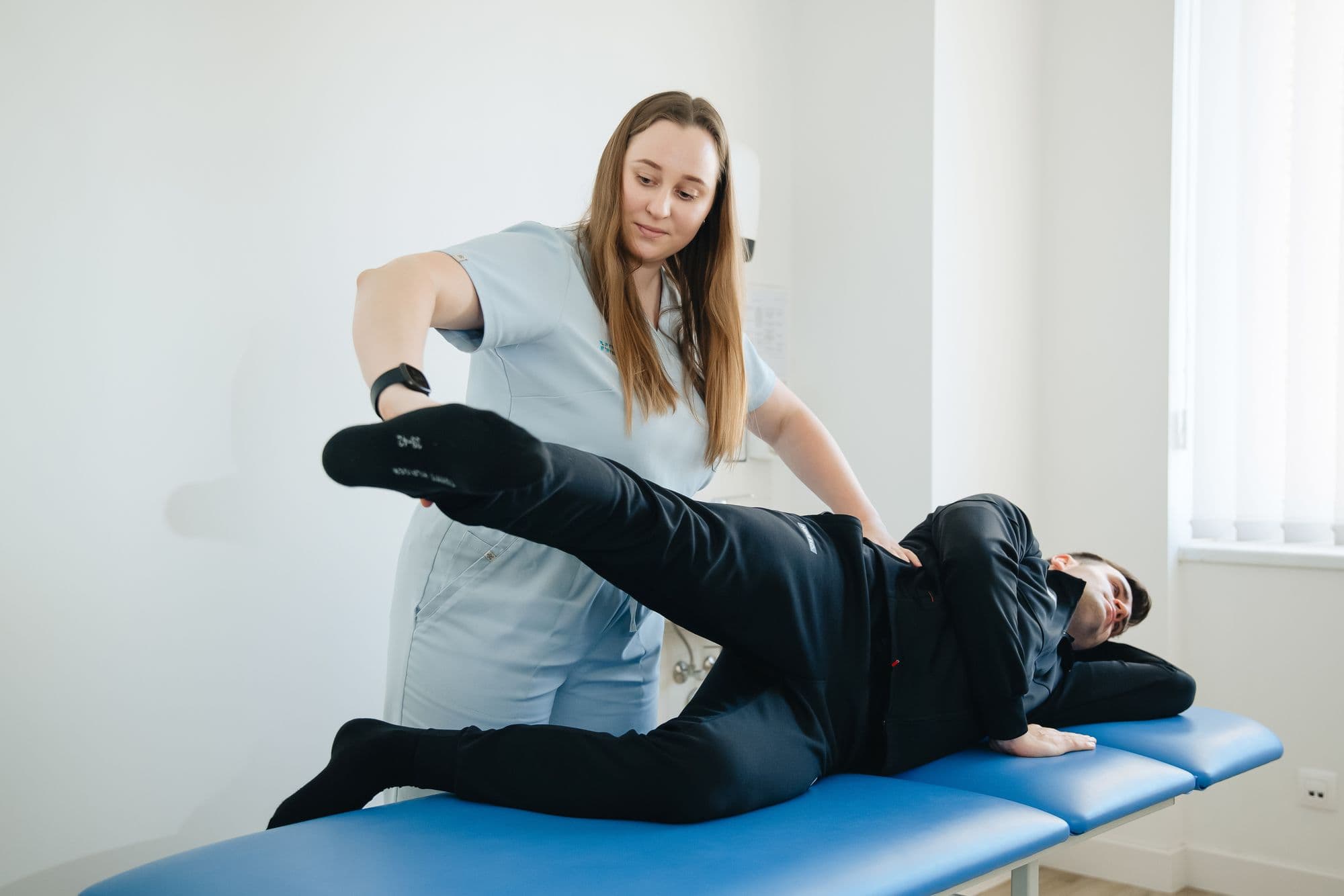
The evaluation measures how the hip moves, how strong the muscles around it are — the gluteals especially — and how you walk, squat, and stand on one leg. It also screens the back and knee, because hip problems are rarely confined to the hip.
Treatment is mainly progressive exercise for the hip, trunk and leg, with hands-on treatment for stiffness and pain and practical advice on the positions and habits that aggravate the tendons. For arthritis it also includes walking and conditioning that you can keep doing on your own, because the benefit lasts only as long as the exercise does.
Most hip problems are seen once or twice a week for six to twelve weeks. Tendinopathy improves over months, not weeks, and we say so at the start.
How we treat it
The services that apply.
Physical Therapy
Pain and movement problems treated without drugs or surgery. Offered at every clinic.
Learn moreAquatic Therapy
The same rehabilitation in warm water, where buoyancy lets you move and load a joint earlier.
Learn moreDry Needling
A thin-needle technique for tight muscle, used inside a wider plan — never on its own.
Learn more
FAQ
Common questions
- Can physical therapy help hip arthritis, or do I need a replacement?
- Physical therapy is the first-line treatment for hip osteoarthritis in every major guideline. Structured strengthening and walking reduce pain and improve function for most people, and many delay or avoid replacement. Surgery is the right option when pain limits daily life despite a proper trial of conservative care.
- Why does my hip hurt when I lie on my side?
- Side-lying compresses the gluteal tendons over the bony point of the hip — the most common cause of outer-hip pain, often called bursitis. A pillow between the knees and progressive gluteal strengthening are the mainstays of treatment; stretching the outside of the hip usually aggravates it.
- How soon after a hip replacement should physical therapy start?
- Usually within days of surgery, following your surgeon's protocol. Early walking and strengthening are linked to a faster, better recovery.
- Do you treat hip pain at every SportsCare clinic?
- Yes. Orthopedic physical therapy, arthritis care and joint replacement rehabilitation are offered at nearly every SportsCare location.
Sources
- Osteoarthritis in over 16s: diagnosis and management (NG226) — National Institute for Health and Care Excellence
- Osteoarthritis of the Hip — OrthoInfo, American Academy of Orthopaedic Surgeons
- Education plus exercise versus corticosteroid injection use versus a wait and see approach on global outcome and pain from gluteal tendinopathy: prospective, single blinded, randomised clinical trial — BMJ, 2018
- Hip arthroscopy versus best conservative care for the treatment of femoroacetabular impingement syndrome (UK FASHIoN): a multicentre randomised controlled trial — The Lancet, 2018
- Hip Bursitis — OrthoInfo, American Academy of Orthopaedic Surgeons
- Hip pain in adults — NHS
This page is general information, not a diagnosis. A physical therapist at any SportsCare clinic can evaluate your specific situation.