
Services
Aquatic Therapy
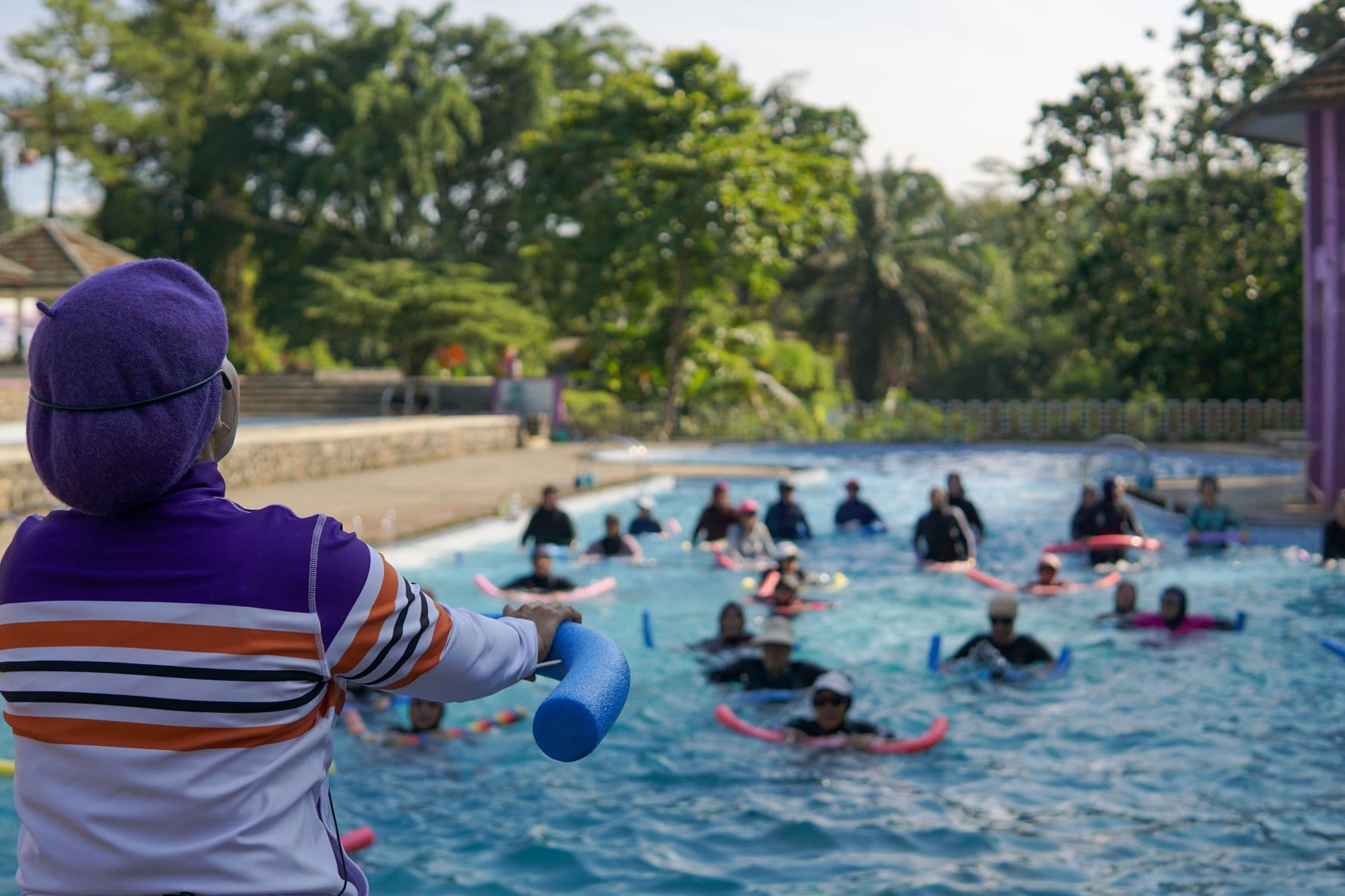
Aquatic therapy is physical therapy performed in a warm-water pool. Buoyancy carries a large share of your body weight, which lets you move — and load a joint — earlier and more comfortably than you could on land. It is the same rehabilitation, in a setting that temporarily removes gravity as an obstacle.
Why SportsCare
Why patients choose SportsCare for aquatic therapy
A dedicated warm-water therapy pool
Our Mountain Lakes pool is kept far warmer than a lap pool, because warmth is part of the treatment. Very few outpatient practices in the region run their own.
Moving sooner when land hurts too much
If a knee or a spine cannot yet tolerate walking on land, the pool lets you start now rather than waiting. Momentum early tends to matter more than intensity later.
The pool is a bridge, and we say so
The goal is always to get you back onto land, where your life happens. We plan that handover from the first session instead of keeping you in the water indefinitely.
Why water changes what you can do
Stand in water and buoyancy pushes up against gravity. The deeper you go, the more of your weight the water carries and the less your joints have to. That single fact is what makes the pool useful: a knee that cannot yet tolerate walking on land may tolerate walking in chest-deep water on the same day.
Two other properties matter. Hydrostatic pressure — water pressing evenly on the immersed body — helps limit swelling and supports circulation. And warm water, typically in the low nineties Fahrenheit, relaxes guarded muscle in a way a cold pool does not. A lap pool and a therapy pool are not the same environment.
Water also resists movement in every direction, so it doubles as gentle, adjustable strengthening: move faster and the resistance rises on its own, with no weight to drop.
Waist deep
You carry about half your weight
Chest deep
You carry roughly a quarter to a third
Neck deep
You carry around a tenth
What it is good for
Aquatic therapy is not a better version of land therapy. It is the right choice in specific circumstances, usually when loading is the limiting factor.
- Knee or hip osteoarthritis
- Why water helpsMovement without the joint compression that provokes pain
- What usually followsProgression to land-based strengthening as tolerance builds
- Chronic low back pain
- Why water helpsSpinal offloading and reduced guarding in warm water
- What usually followsGraded return to land-based loading and conditioning
- After surgery with weight-bearing limits
- Why water helpsControlled partial weight-bearing by choosing depth
- What usually followsGradual reduction in depth as restrictions are lifted
- Balance problems and fear of falling
- Why water helpsPracticing at the edge of balance where a fall does not hurt
- What usually followsConfidence carried back onto land
What the evidence shows
The strongest support is for osteoarthritis of the knee and hip, fibromyalgia, and balance problems in older adults. For chronic low back pain, a systematic review and meta-analysis found aquatic physical therapy reduced pain intensity and disability and improved quality of life compared with controls, with benefits still present at three, six and twelve months.
The honest caveat is that water is a means, not an end. Almost everyone should be working towards land, because land is where daily life happens. Aquatic therapy that never transitions has stopped being rehabilitation and become an exercise class.
Well supported
- Knee and hip osteoarthritis — the strongest evidence base
- Chronic low back pain, with benefit sustained to twelve months
- Fibromyalgia and widespread pain
- Balance and fall-risk reduction in older adults
Worth knowing
- Water is a bridge to land-based loading, not a destination
- Bone and muscle need load — offloading forever works against you
- Not appropriate for everyone; see the eligibility list below
- Availability is limited — we have one therapy pool
What a session is like
Before you get in
Your therapist evaluates you on land first and sets the plan. You will need a swimsuit and a towel; we will talk you through access to the pool, including steps or a lift if you need one.
In the water
Sessions typically run 30 to 45 minutes. Depth is chosen deliberately — deeper to offload more, shallower to load more — and the work looks like walking, controlled resistance movement, and balance tasks rather than swimming. You do not need to be able to swim.
Progression
As tolerance improves you move to shallower water, which loads the joint more, until you are ready to do the same work on land. That handover is the goal from the first session.
Who the pool is not right for
Aquatic therapy is safe for most people, but a shared warm-water pool has requirements that a treatment table does not.
FAQ
Common questions
- Do I need to know how to swim?
- No. Aquatic therapy takes place in water where you can stand, and a therapist is with you throughout. Nothing in the program requires swimming, and flotation support is available if it helps you feel secure.
- How warm is the pool?
- A therapy pool is kept considerably warmer than a lap pool — typically in the low nineties Fahrenheit. That warmth is part of the treatment: it relaxes guarded muscle and makes movement more comfortable for painful joints.
- How much weight does the water actually take off my joints?
- It depends on depth. Standing in water to roughly waist height leaves you carrying about half your body weight. At chest height that falls to around a quarter to a third, and up at neck height you are bearing roughly a tenth. Your therapist chooses depth to match what your joint can tolerate.
- Is aquatic therapy covered by insurance?
- It is generally billed as physical therapy, but coverage varies by plan and some carriers treat it differently. Call the clinic with your insurance card before your first visit and the front desk will verify your benefits.
- Where can I get aquatic therapy with SportsCare?
- Our aquatic therapy pool is at the Mountain Lakes clinic in New Jersey. Because it is a single pool serving a wide area, scheduling is more limited than for land-based therapy — call ahead to check availability.
Sources
The clinical claims on this page are drawn from the following. Where the evidence is limited, we say so above rather than round it up.
- 1.Effect of aquatic physical therapy on chronic low back pain: a systematic review and meta-analysis — BMC Musculoskeletal Disorders
Where we offer aquatic therapy
This program runs at one of our clinics. Call ahead to check availability.
Mountain Lakes
Mountain Lakes, NJ
(973) 402-1600
Talk to a therapist about aquatic therapy
Availability varies by clinic. Call the location nearest you and the front desk will tell you whether it is offered there and whether it suits your condition — or reach our main office at (973) 887-9000.
64 clinics across New Jersey, New York and Florida.