
Services
Video Gait Analysis
Most running injuries are load problems: too much, too soon, on a body with a weak link. Filming you run shows us the link — an overstriding foot, a collapsing hip, a cadence that is too slow — and the research on running retraining tells us which of those are worth changing. Then we manage the return to running so it is a plan rather than a hope.
Why SportsCare
Why runners choose SportsCare
Analysis by a therapist who treats runners
The person filming you is a physical therapist who then treats the injury, not a shop assistant matching you to a shoe. The analysis is the start of a plan, not the end of a sale.
AlterG anti-gravity treadmills at select clinics
Running at 60–80% of your body weight lets you keep running earlier in recovery, and lets us retrain your gait without the full load. Available at select locations.
Retraining backed by evidence
A 2016 review in the British Journal of Sports Medicine synthesised the research on running retraining; we use the changes with support — cadence, foot strike, step width — and skip the ones without.
Running injuries we treat
Iliotibial band syndrome. Patellofemoral pain (runner's knee). Patellar tendinopathy. Medial tibial stress syndrome (shin splints) and stress reactions. Plantar fasciitis. Achilles tendinopathy. Hamstring, calf and hip flexor strains. Hip bursitis and gluteal tendinopathy. Low back pain in runners. Each has its own page under Conditions with the evidence and the warning signs; this page is about the running-specific layer we add on top.
What a video gait analysis involves
History and examination
Your training history — mileage, pace, surfaces, shoes, what changed before the pain started — plus strength, mobility and single-leg control.
Filming
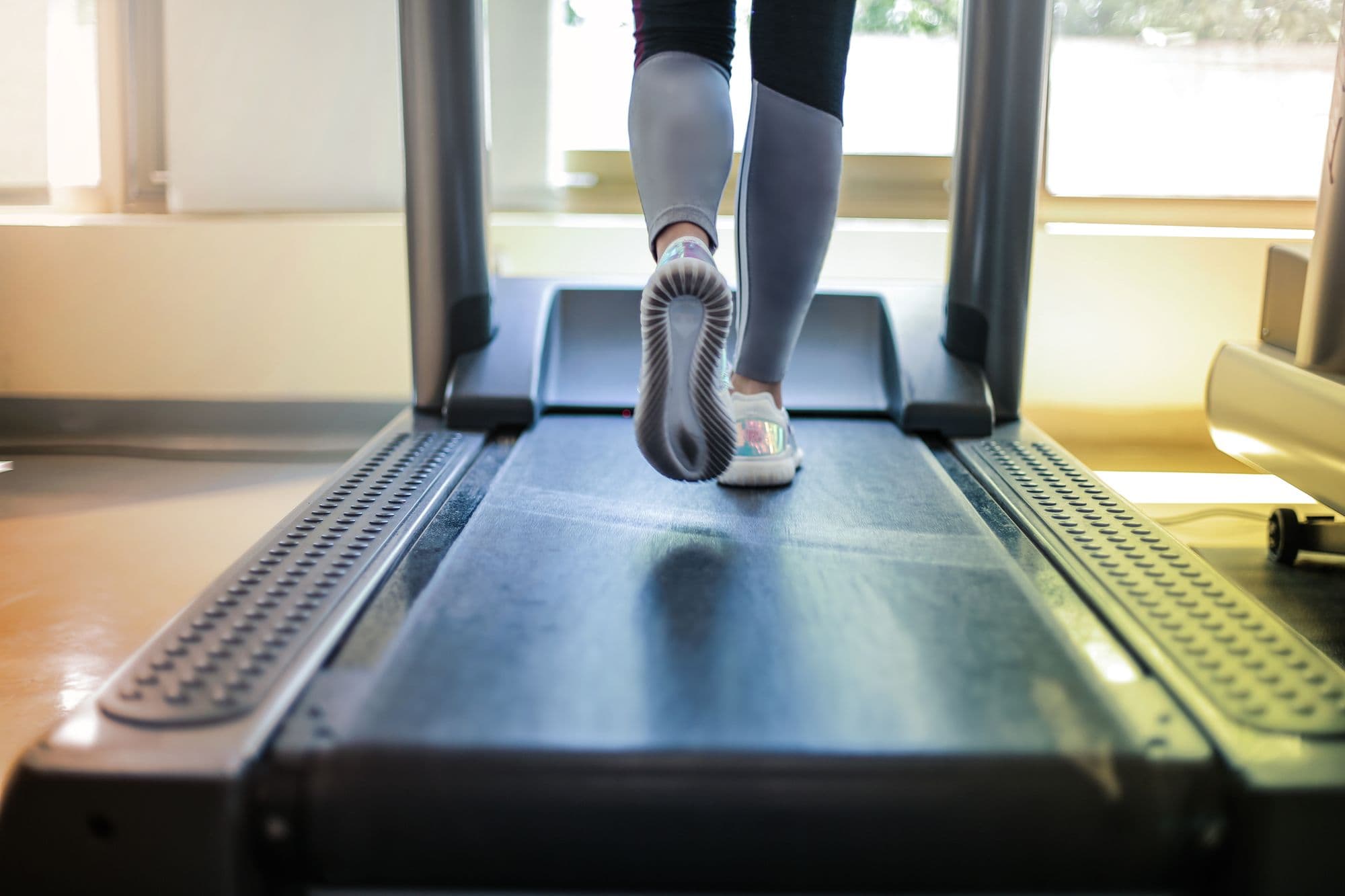
Slow-motion video on the treadmill from behind and from the side, at an easy pace and at your usual training pace.
Analysis
Cadence, stride length, foot strike, knee and hip position at landing, pelvic drop, trunk lean — measured, not eyeballed, and explained on screen with you.
A written report and a plan
Photos and measurements, one or two gait changes worth making, strength and mobility work, drills, a warm-up, and — most important — a load plan for getting back to your mileage.
What the evidence supports changing
Increasing cadence by 5–10% reduces the load on the knee and hip at each step and is the best-supported single change in the running retraining literature. Reducing overstriding and a heavy heel strike helps some runners with knee pain. Cueing a wider step width can help IT band and shin symptoms. Shifting a runner from a rearfoot to a forefoot strike reduces knee load but increases calf and Achilles load, so it is a trade, not a cure, and we say so.
Footwear: the evidence that a particular shoe type prevents injury is weak. We look at what you run in and suggest changes only where there is a specific reason. What matters more than the shoe is how quickly you change to it.
Returning to running
The most common reason a running injury comes back is a return that jumps straight to old mileage. We write the return as a schedule — walk-run intervals, then continuous running, then volume, then intensity — with a rule for what to do when symptoms appear. Where an AlterG treadmill is available, running at reduced body weight lets that schedule start weeks earlier.
FAQ
Common questions
- Do I need to be injured to have a gait analysis?
- No. Runners with an injury use it to find the cause; runners without one use it to find the weak link before it becomes an injury, or to prepare for a jump in training such as a first marathon.
- Should I change to a forefoot strike?
- Not automatically. A forefoot strike reduces load on the knee but increases it on the calf and Achilles. It helps some runners with knee pain and hurts some with Achilles problems. Cadence is a safer first change for most people.
- What should I bring?
- The shoes you run in most, running clothes, and if you use one, your watch or app with your recent training history.
- Which clinics have an AlterG treadmill?
- AlterG anti-gravity treadmills are at select SportsCare clinics. Video gait analysis itself is available at more locations; call the clinic nearest you to confirm both.
Sources
The clinical claims on this page are drawn from the following. Where the evidence is limited, we say so above rather than round it up.
- 1.Running retraining to treat lower limb injuries: a mixed-methods study of current evidence synthesised with expert opinion — British Journal of Sports Medicine, 2016
- 2.Patellofemoral Pain Syndrome — OrthoInfo, American Academy of Orthopaedic Surgeons
- 3.Achilles Tendinitis — OrthoInfo, American Academy of Orthopaedic Surgeons
Talk to a therapist about video gait analysis
Availability varies by clinic. Call the location nearest you and the front desk will tell you whether it is offered there and whether it suits your condition — or reach our main office at (973) 887-9000.
64 clinics across New Jersey, New York and Florida.