
Conditions
Knee pain and injuries
The knee is the joint people most often assume needs surgery and least often actually does. For arthritis, for most meniscus tears in adults, and for kneecap pain, exercise-based physical therapy is the recommended first step — and for the injuries that do need an operation, the rehabilitation afterward decides how well it turns out.
See a doctor first
A knee with any of the following should be seen by a physician or an urgent care before a therapy visit:
- You cannot put weight on it at all, or it gives way completely
- Obvious deformity, or a kneecap that has moved out of place
- A hot, red, swollen knee with fever — a joint infection is an emergency
- Sudden swelling within an hour or two of an injury, especially with a pop you felt or heard
- Calf pain and swelling with the knee pain, which can signal a blood clot
What we see most
Knee conditions we treat, and what therapy does for each.
Knee osteoarthritis
Wear of the joint cartilage, usually after 50. Stiffness in the morning, pain on stairs and after sitting, and a knee that feels less trustworthy over time.
What therapy does: Exercise is the treatment every major guideline puts first for knee arthritis — ahead of injections and well ahead of surgery — because strengthening the muscles around the joint reduces pain and improves function about as much as anti-inflammatory medication, without the side effects. Therapy cannot regrow cartilage, and we will not tell you it can. It can very often keep you walking, working and off the replacement list for years.
ACL tears
A tear of the anterior cruciate ligament, usually from a pivot or landing rather than a collision. Common in soccer, basketball, skiing and lacrosse, and more common in women than men.
What therapy does: Whether you have surgery or not, rehabilitation is where the outcome is decided. Before surgery, restoring full extension and quadriceps control improves the result. After it, a structured nine-to-twelve-month program — with objective tests before return to sport — is what lowers the risk of re-tearing. Some people, especially those not returning to pivoting sports, do well without reconstruction.
Meniscus tears
A tear of the cartilage cushion inside the knee. In young athletes it is usually a twisting injury; over 40 it is more often degenerative and may be found on a scan of a knee that hurts for other reasons.
What therapy does: For degenerative meniscus tears in adults, several high-quality trials found that exercise therapy produces results equal to arthroscopic surgery, so therapy is the recommended first step. A tear that locks the knee — you cannot fully straighten it — is the exception, and needs a surgeon's opinion.
Patellofemoral pain (runner's knee)
Aching pain around or behind the kneecap, worse on stairs, squatting and sitting with the knee bent. The most common knee complaint in active people under 40.
What therapy does: The evidence points to hip and thigh strengthening, not to the kneecap itself: weak hip muscles let the knee drift inward under load. We assess how you squat, land and run, strengthen what is not holding up, and adjust training load so you keep running while it settles.
Total knee replacement recovery
Rehabilitation after a partial or total knee replacement, from the first days after surgery to walking without a limp.
What therapy does: The two things that most determine a good result are regaining full straightening early and keeping the knee moving through the painful first weeks. We follow your surgeon's protocol, manage swelling, restore range, then rebuild strength and confidence on stairs, slopes and uneven ground. Total joint replacement rehabilitation is offered at nearly every SportsCare clinic.
Do you need an MRI?
Usually not first. Knee MRIs are very sensitive, which sounds like a good thing until you learn that they find meniscus tears and cartilage wear in a large share of adults who have no knee pain at all. For most knee pain without red-flag signs, an examination and a few weeks of well-designed treatment tell us more than a scan does.
An MRI earns its place when the knee is locking, when there was a clear injury with immediate swelling, or when a genuine trial of therapy has not moved things. Your therapist will say so if that point is reached.
What treatment looks like
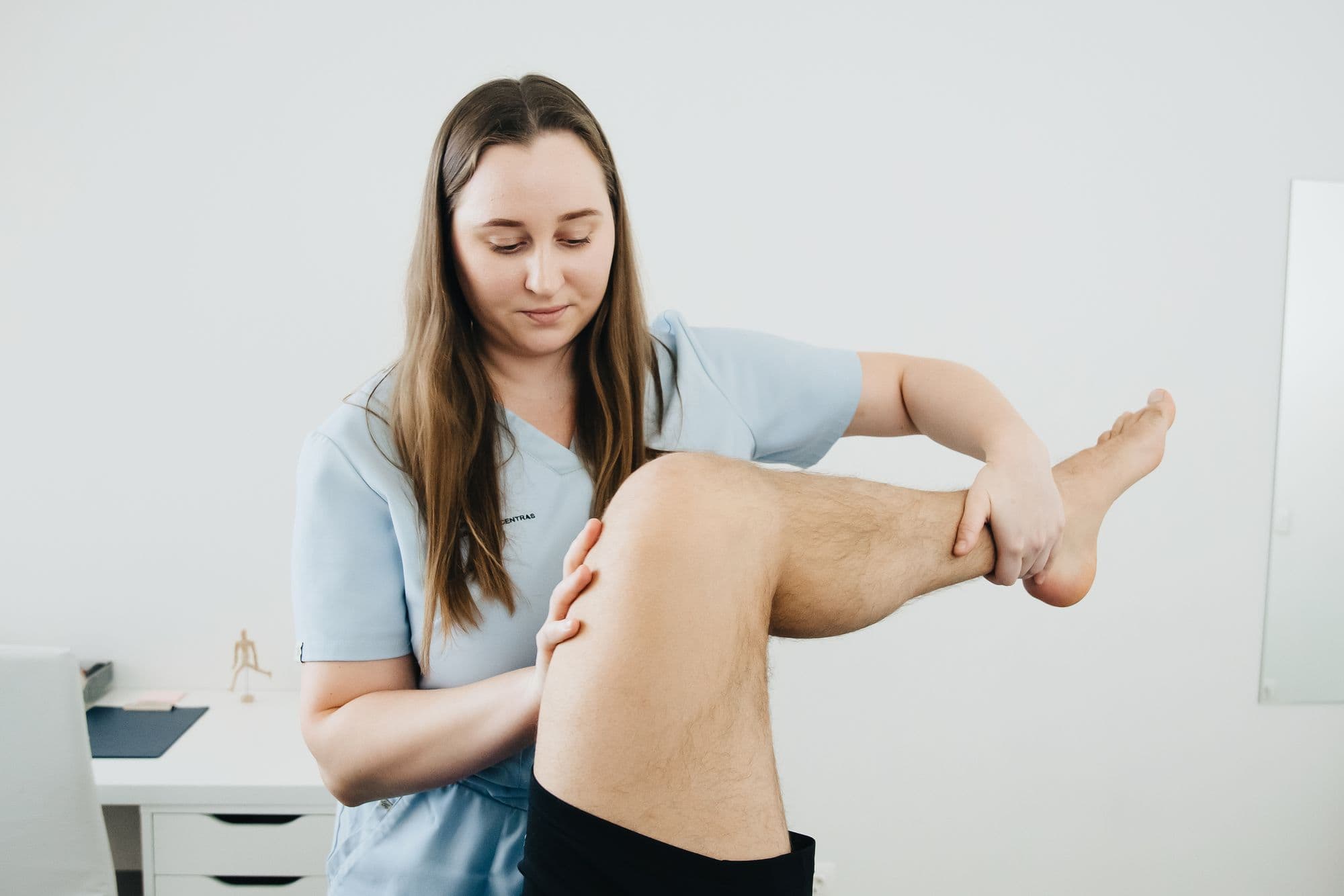
The first visit is an examination: how the knee moves, how it is loaded when you walk, squat and step down, how strong the muscles around it are, and how your hip and ankle are contributing. Most knee problems are load problems, and the load usually comes from somewhere other than the knee.
Treatment is mainly progressive exercise — quadriceps, hip and calf strength, control on one leg, then the specific demands of your sport or your job — with hands-on treatment for stiffness and swelling as needed. Braces, taping and other passive tools have a supporting role at most.
We measure as we go: strength, range, single-leg tests, hop tests for athletes. Return to sport after an ACL reconstruction is a decision made on those numbers, not on the calendar.
How we treat it
The services that apply.
Physical Therapy
Pain and movement problems treated without drugs or surgery. Offered at every clinic.
Learn moreAquatic Therapy
The same rehabilitation in warm water, where buoyancy lets you move and load a joint earlier.
Learn moreDry Needling
A thin-needle technique for tight muscle, used inside a wider plan — never on its own.
Learn more
FAQ
Common questions
- Can physical therapy help knee arthritis, or do I need a replacement?
- Physical therapy is the first-line treatment for knee osteoarthritis in every major guideline. Structured strengthening reduces pain and improves function for most people, and many delay or avoid replacement. Surgery becomes the right option when pain limits daily life despite a proper trial of exercise and other conservative care.
- Does a meniscus tear need surgery?
- Often not. For degenerative meniscus tears in adults, exercise therapy produces outcomes comparable to arthroscopic surgery in randomized trials, so therapy is the recommended first step. A knee that locks and cannot fully straighten should be seen by an orthopedic surgeon.
- How long is rehabilitation after an ACL reconstruction?
- Typically nine to twelve months before return to pivoting sports, with objective strength and hop testing before clearance. Returning earlier than that is associated with a higher risk of re-injury.
- How soon after a knee replacement should physical therapy start?
- Usually within days of surgery, following your surgeon's protocol. Early movement and regaining full extension are strongly linked to a better long-term result.
Sources
- Management of Osteoarthritis of the Knee (Non-Arthroplasty): Evidence-Based Clinical Practice Guideline — American Academy of Orthopaedic Surgeons, 2021
- Osteoarthritis in over 16s: diagnosis and management (NG226) — National Institute for Health and Care Excellence
- Exercise therapy versus arthroscopic partial meniscectomy for degenerative meniscal tear in middle aged patients: randomised controlled trial — BMJ, 2016
- Anterior Cruciate Ligament (ACL) Injuries — OrthoInfo, American Academy of Orthopaedic Surgeons
- Patellofemoral Pain Syndrome — OrthoInfo, American Academy of Orthopaedic Surgeons
- Knee pain — NHS
This page is general information, not a diagnosis. A physical therapist at any SportsCare clinic can evaluate your specific situation.